
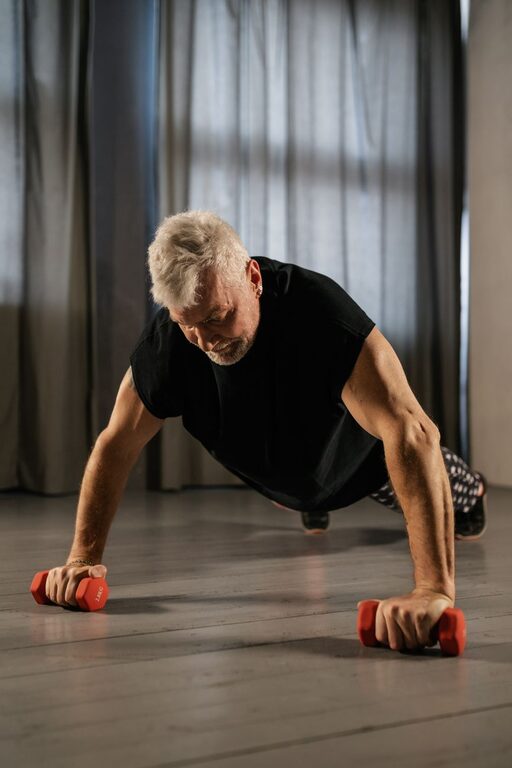
Strength training is a practical way for active older adults to support everyday movement. Regular resistance exercises can make tasks such as carrying groceries, climbing stairs, lifting household items, and getting up from a chair feel more manageable.
You do not need heavy weights or complicated equipment to begin. A sturdy chair, a pair of light dumbbells, and a little open space can provide everything needed for a simple workout.
The goal is to move with control, use good form, and progress gradually. Start with a level that feels manageable, then build strength over time.
Getting Started Safely
Before exercising, spend five to ten minutes warming up. Try easy marching in place, shoulder rolls, gentle arm swings, or a relaxed walk around the room.
Choose a stable surface and wear supportive shoes. Keep a sturdy chair, countertop, or wall nearby for balance when needed. Avoid holding onto furniture that may slide or tip.
During each exercise:
– Breathe steadily instead of holding your breath.
– Move slowly and avoid sudden jerking.
– Keep your movements comfortable and controlled.
– Stop if you feel sharp pain, unusual dizziness, or unwell.
– Leave at least one day between challenging strength sessions when beginning.
If you have questions about which exercises are appropriate for your fitness level, a qualified fitness professional can help you create a suitable routine.
1. Chair Squats
Chair squats strengthen the thighs, hips, and buttocks. They also practice the movement used when sitting down and standing up.
How to do them
- Stand in front of a sturdy chair with your feet about hip-width apart.
- Extend your arms forward or keep them by your sides.
- Bend your knees and slowly lower your hips toward the chair.
- Lightly touch the chair with your hips, if comfortable.
- Press through your feet to return to standing.
Keep your chest lifted and your knees pointing in the same direction as your toes. Avoid dropping heavily into the chair.
Begin with one set of eight to ten repetitions. As the movement becomes easier, try two sets.
2. Wall Push Ups
Wall push-ups work the chest, shoulders, and arms without requiring you to get down on the floor.
How to do them
- Face a clear wall and stand about an arm’s length away.
- Place your palms on the wall at chest height.
- Bend your elbows and slowly bring your chest toward the wall.
- Press through your hands to return to the starting position.
Keep your body in a straight line from your head to your heels. To make the exercise easier, stand closer to the wall. To make it more challenging, step slightly farther away.
Try one or two sets of eight to twelve repetitions.
3. Supported Step Ups
Step-ups strengthen the legs and hips while practicing a movement used for stairs and curbs. Use the bottom step of a staircase or a low, stable platform. Keep a hand near a railing or wall for support.
How to do them
- Stand facing the step with both feet on the floor.
- Place one foot fully on the step.
- Press through that foot and bring the other foot up.
- Step down carefully, leading with the same foot.
- Repeat on the other side.
Move slowly and focus on placing your whole foot on the step. Start with five repetitions per side and increase gradually.
If the step feels unstable or too high, choose a lower platform or practice marching in place instead.
4. Seated Knee Lifts
Seated knee lifts strengthen the muscles around the hips and help improve control during walking and daily movement.
How to do them
- Sit tall near the front of a sturdy chair.
- Keep both feet flat on the floor.
- Lift one knee a few inches without leaning backward.
- Lower the foot with control.
- Repeat with the other leg.
Alternate sides for eight to twelve repetitions per leg. Keep your shoulders relaxed and your back comfortably upright.
For an added challenge, pause briefly at the top of each lift.
5. Standing Calf Raises
Calf raises work the lower legs and can support stronger, steadier steps. Use a countertop or the back of a sturdy chair for balance.
How to do them
- Stand tall with your feet hip-width apart.
- Hold the support lightly.
- Slowly rise onto the balls of your feet.
- Pause for a moment.
- Lower your heels with control.
Try one or two sets of ten to fifteen repetitions. Keep your weight spread evenly across the front of your feet instead of rolling outward.
6. Bent Over Rows
Rows strengthen the upper back and arms. You can use light dumbbells, water bottles, or no weight at first.
How to do them
- Stand with your feet hip-width apart and hold a light weight in each hand.
- Bend your knees slightly and hinge forward from your hips.
- Keep your back long and your shoulders relaxed.
- Pull your elbows gently toward your ribs.
- Lower the weights slowly.
Avoid rounding your back or lifting your shoulders toward your ears. Begin with one set of eight to twelve repetitions.
If standing feels tiring, perform the exercise while seated with your feet firmly on the floor.
7. Standing Hip Abductions
This exercise targets the muscles on the sides of the hips, which help with side-to-side movement and stability.
How to do them
- Stand behind a sturdy chair and hold it lightly.
- Keep your torso upright and your toes facing forward.
- Move one leg out to the side without leaning.
- Return the leg to the starting position.
- Repeat on the other side.
Perform eight to twelve repetitions per leg. Keep the movement small and controlled. The goal is not to lift the leg as high as possible.
Creating a Simple Weekly Routine
A beginner strength routine can be completed two or three days per week. Allow time for rest between sessions, especially when trying new exercises.
A sample workout might include:
– Chair squats: 8 to 10 repetitions
– Wall push-ups: 8 to 12 repetitions
– Supported step-ups: 5 per side
– Bent-over rows: 8 to 12 repetitions
– Standing calf raises: 10 to 15 repetitions
– Standing hip abductions: 8 to 12 per side
Start with one round of the routine. Rest for about 30 to 90 seconds between exercises, depending on how you feel. After several sessions, consider adding a second round or a few repetitions.
How to Progress Gradually
Progress does not always mean lifting heavier weights. You can make an exercise more challenging by:
– Adding a few repetitions
– Completing an extra set
– Moving more slowly
– Pausing briefly during the hardest part
– Using slightly heavier weights
– Reducing the amount of support, when balance allows
Change only one part of the workout at a time. This makes it easier to notice how your body responds and maintain good form.
Strength training should feel purposeful, not rushed. With consistent practice, these beginner-friendly exercises can become a useful part of an active lifestyle and support confident movement at home, outdoors, and during favorite activities.